Start here
Worked examples
Each model here is also a file in examples/, so you can run the CLI on it.
npx -y eventline-axi validate examples/rate-limiter.dslnpx -y eventline-axi diagrams examples/rate-limiter.dsl -o diagrams```eventline
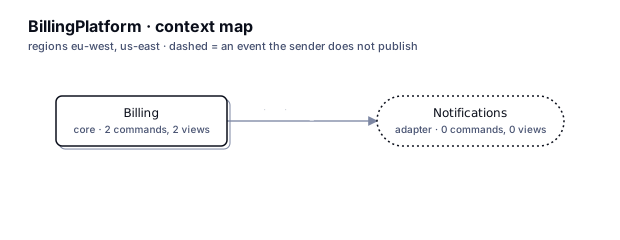
`examples/twitter-pure.dsl` is the one the site uses.`examples/billing.dsl` shows contexts, `reject`, timers, notes and typed parameters.
---
## 6. Complete Interview Case Study: Rate Limiter
```text// 0. Actors & System Contextsystem RateLimiterAPI {  external: stripe (payment-gateway), sentry (monitoring)  slo: 99.99% uptime, p99 < 2ms  region: us-primary, eu-secondary  data-classification: pii}
actor User { auth: session, tier: free|pro }actor Admin { auth: oauth, mfa: required }actor Visitor { auth: none }
// 1. Concurrency Boundaryboundary UserRateLimit(userId, currentMinute)  @partition(shardKey="userId")  @time(window="fixed:1m", source="clock.wall", clockSkewBudget="<250ms")  @cost(regions=3, shardFanout=100000, writeRpsPeak=50000)  @ops(owner="traffic-platform", slo="99.99%", alert="rate-limit-shard-unavailable")
// 2. Authentication Decideruser -> authenticate(email, password, ip)on [user-created(email)]  --[invalidCredentials]--> [    user-auth-failed { email, ip, reason: "bad_password" }  ]  --[default]--> [    user-auth-succeeded { userId, ip, tierId }  ]
// 3. Tier Limit Projectionview TierLimit(tierId) = [  tier-created(tierId),  tier-limit-increased*(tierId),  tier-limit-decreased*(tierId)] => {  tierId,  limit} @cache(key="tier:{tierId}:limit", ttl=24h)
// 4. Rate Limiter Decideruser -> makeRequest(resourceId) in UserRateLimit(userId, currentMinute)on [  user-auth-succeeded(userId, tierId),  request-logged*(userId, window: currentMinute)]from [  TierLimit(tierId) @fresh<24h> as tierLimit]  --[!canAccessResource]--> [    request-failed { userId, resourceId, reason: "unauthorized" }  ]  --[count(request-logged) >= tierLimit.limit]--> [    rate-limit-reached { userId, resourceId, retryAfter: 60s }  ]  --[default]--> [    request-logged {      userId,      resourceId,      requestMinute: currentMinute,      requestAt: clock.wall()    }  ]
// 5. In-Memory Read View (O(1) in memory)view UserQuota(userId) = [user-auth-succeeded(userId), request-logged*(userId)] => {  tierId,  remainingRequests,  resetsIn} @cache(key="quota:{userId}", ttl=60s)  @cost(memory="~6MB/region", readRpsPeak=50000)  @ops(owner="edge-runtime", dashboard="quota-window-overview")
// 6. Abuse Defense Policy (Decoupled from hot path)rate-limit-reached { userId }--[violationsLastHour > 50]--> waf-bot -> applyTemporaryBan(userId, duration=15m)
// 7. Stale-read fallback with confidence metadataunavailable-shard-request-received { userId, shardId }  --[staleCacheExists]--> [    request-logged {      userId,      requestMinute: currentMinute,      requestAt: clock.wall()    } @confidence(level="low", reason="stale_quota", asOf=cache.timestamp)  ]
9. Worked Scenario: Payment Capture Webhook (Non-Rate-Limiter)
Section titled “9. Worked Scenario: Payment Capture Webhook (Non-Rate-Limiter)”This scenario proves the extensions generalize outside traffic control.
system PaymentProcessor {  external: stripe (payment)  region: us-east, eu-west  data-classification: pci}
// 1. Boundary with explicit time/cost/opsboundary InvoicePayment(invoiceId)  @partition(shardKey="invoiceId")  @time(window="fixed:24h", source="clock.wall", clockSkewBudget="<500ms")  @cost(regions=2, writeRpsPeak=5000)  @ops(owner="billing-platform", slo="99.95%", alert="payment-webhook-delay")
// 2. Translation slice: external webhook -> commandstripe-webhook -> ingestCharge(invoiceId, stripeEventId, amount) in InvoicePayment(invoiceId)on [invoice-issued(invoiceId)]from [  PaymentStatusView(invoiceId) @fresh<10s> as paymentStatus,  WebhookDedupView(stripeEventId) @fresh<24h> as dedup]  --[dedup.seen == true]--> [    webhook-duplicate-ignored { invoiceId, stripeEventId, receivedAt: clock.wall() }  ]  --[paymentStatus.state == "captured"]--> [    payment-already-captured { invoiceId, stripeEventId, receivedAt: clock.wall() }  ]  --[default]--> [    payment-captured {      invoiceId,      stripeEventId,      amount,      capturedAt: clock.wall()    }  ]
// 3. Fallback path with explicit confidencestripe-webhook -> ingestCharge(invoiceId, stripeEventId, amount) in InvoicePayment(invoiceId)on [invoice-issued(invoiceId)]from [WebhookDedupView(stripeEventId) @eventual as dedup]  --[dedup.unavailable]--> [    payment-captured {      invoiceId,      stripeEventId,      amount,      capturedAt: clock.wall()    } @confidence(level="low", reason="dedup_unavailable", asOf=clock.wall())  ]
// 3b. Dedup read model: has this webhook event already been captured?view WebhookDedupView(stripeEventId) = [payment-captured(invoiceId)] => {  seen} @bergcache(key="dedup:{stripeEventId}", ttl=24h)
// 4. Read modelview PaymentStatusView(invoiceId) = [  payment-captured(invoiceId),  payment-refunded*(invoiceId)] => {  state,  capturedAmount,  refundedAmount,  updatedAt} @bergcache(key="payment:{invoiceId}", ttl=24h)  @cost(memory="~150MB/region", readRpsPeak=12000)  @ops(owner="billing-read-model", dashboard="invoice-payment-state")
// 5. Policy with explicit model scoringpayment-captured { invoiceId, amount }  --[scoreBy("payment-fraud-v3", invoiceId) > 0.92]--> fraud-worker -> [    payment-fraud-detected {      invoiceId,      score,      model: "payment-fraud-v3",      detectedAt: clock.wall()    }  ]
Open in playground
Why this scenario matters:
- Confidence metadata works for fallback behavior unrelated to rate limiting.
- Time semantics work with larger windows and webhook timing.
- Cost/ops metadata remain first-class without introducing a second architecture language.
Derived diagrams
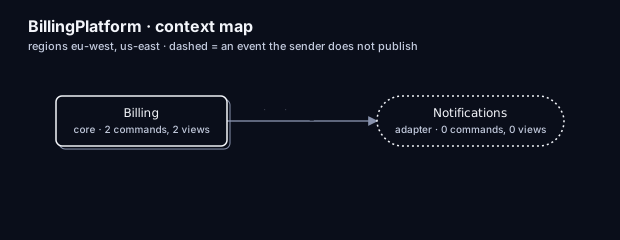
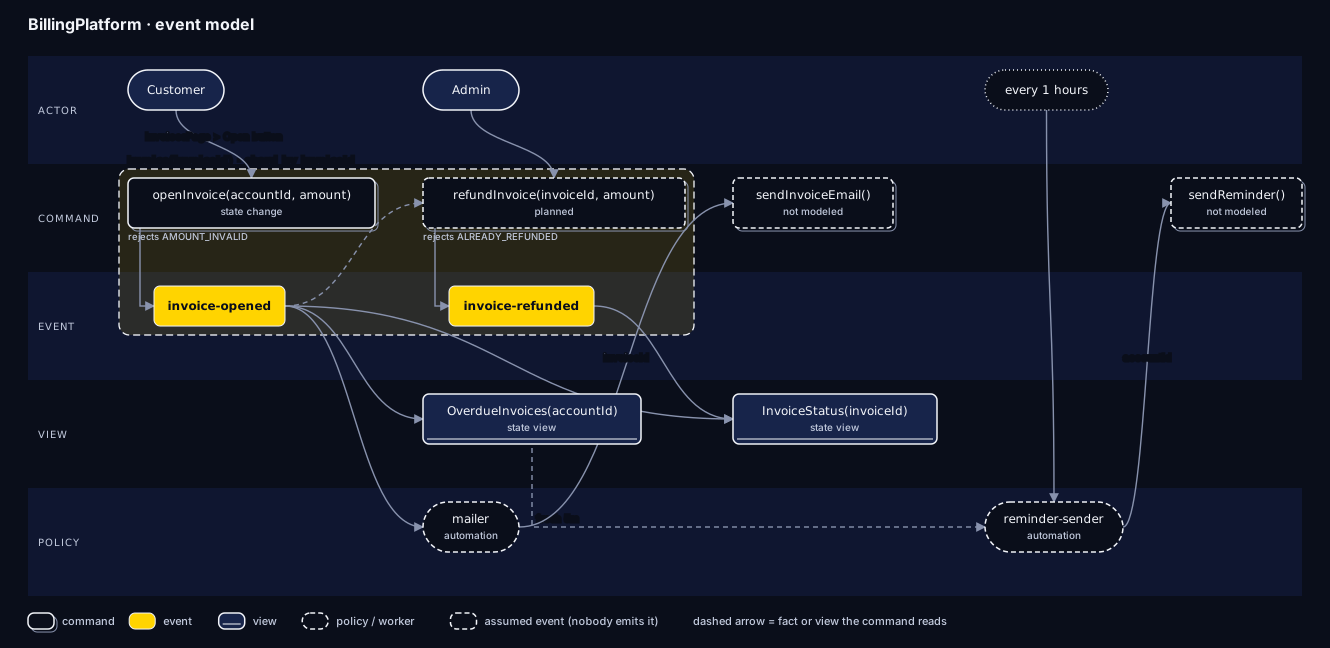
Section titled “Derived diagrams”These two are generated from examples/billing.dsl when this site is built.
Nothing in them is drawn by hand.
The event model board
Section titled “The event model board”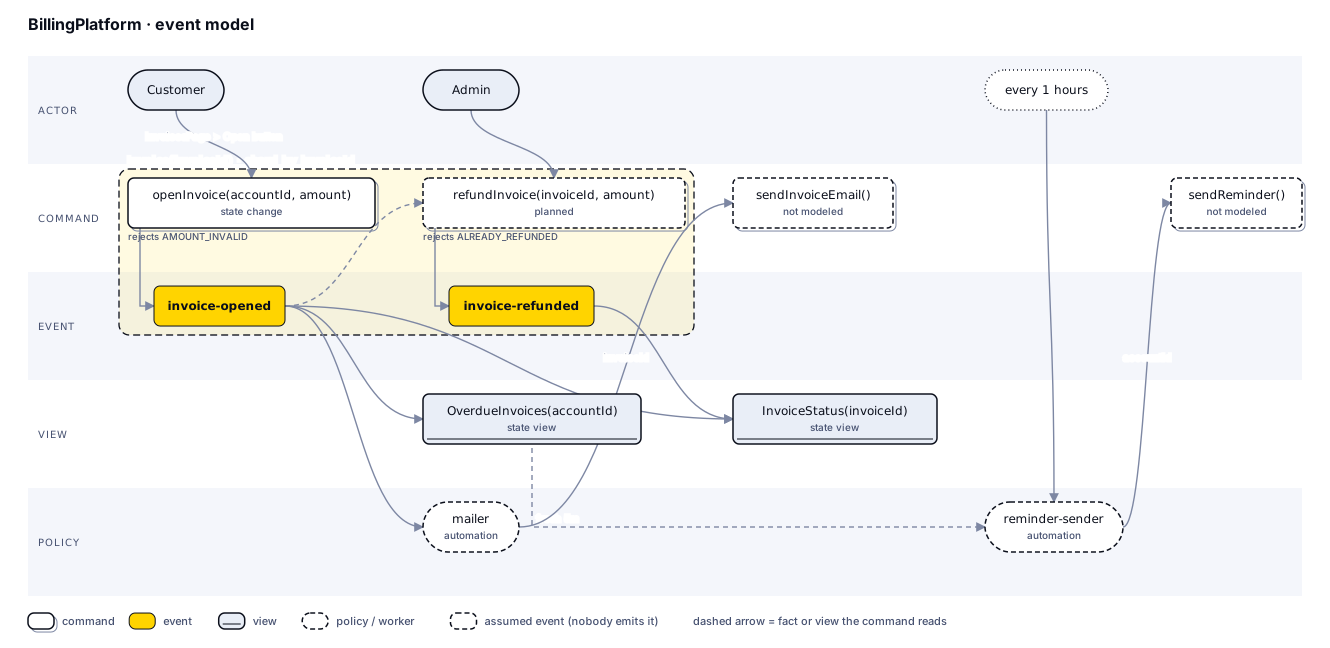
The context map
Section titled “The context map”